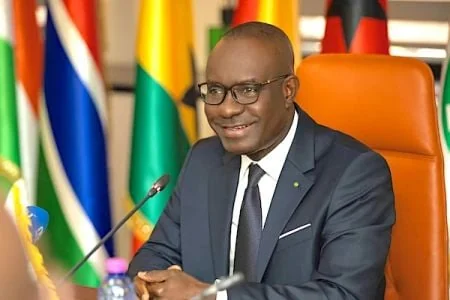
The President of the ECOWAS Bank for Investment and Development (BIDC), Dr. George Agyekum Donkor, has been awarded the African Leadership Excellence Award for regional integration and economic transformation. The recognition comes as the bank is named strategic partner for the ALM Africa 2026 summit, highlighting its role in bridging policy and finance. Yet this institutional milestone contrasts with persistent challenges: informal trade continues to drain $10 billion annually from West African economies, and cross-border commerce remains fraught with obstacles, as recent analyses have shown.
🏆 BIDC honorée — mais le commerce ouest-africain reste entravé
Le président de la BIDC reçoit un prix d'excellence pour l'intégration régionale, alors que les pertes liées au commerce informel persistent.
- ✓ Dr. George Agyekum Donkor reçoit l'African Leadership Excellence Award
- ✓ BIDC nommée partenaire stratégique du sommet ALM Africa 2026
- ✓ Rôle reconnu : pont entre politique publique et investissement privé
- ❌ 10 milliards $ perdus chaque année dans le commerce informel
- ❌ Échanges entre Abidjan, Lagos, Dakar, Accra, Bamako toujours entravés
- ❌ Écart persistant entre objectifs d'intégration et réalités commerciales
The award to Dr. Donkor and the BIDC's designation as strategic partner for ALM Africa 2026 are the latest signs of progress in West Africa's integration agenda. The bank, which finances regional infrastructure and development projects, is being recognized for its role in connecting public policy with private investment. This institutional validation comes at a time when the CEDEAO region is grappling with the gap between ambitious integration goals and everyday commercial realities.
Un contraste frappant entre reconnaissance et réalité
While the BIDC's leadership is celebrated on the international stage, the ground-level picture remains complex. According to recent reports, nearly $10 billion are lost annually to informal trade across West Africa, a figure that underscores the persistence of barriers to formal commerce. The scraped articles from May 2026 highlight that despite decades of efforts, trading between cities like Abidjan, Lagos, Dakar, Accra, and Bamako remains a 'parcours semé d'obstacles'. This disconnect between institutional progress and operational hurdles is a central tension in the region's development.
The BIDC, under Donkor's leadership, has been pivotal in mobilizing both concessional and market-rate capital for projects that aim to reduce these barriers. The bank's involvement in financing transport corridors, energy interconnections, and trade facilitation infrastructure is directly relevant to the summit's theme: 'From Vision to Acceleration'. However, the acceleration of regional trade requires not just capital, but also harmonized regulations, reduced non-tariff barriers, and effective customs cooperation.
The timing of the award, just weeks after CEDEAO celebrated its 51st anniversary on May 28, 2026, is symbolic. In the lead-up to that anniversary, the institution had launched a campaign reflecting on its achievements and challenges. The award to the BIDC president can be seen as an external endorsement of the progress made, but it also raises questions about the pace of implementation. The scraped articles note that integration has been a long-standing goal, yet the region still struggles with the basics of intra-community trade.
The ALM Africa 2026 summit, where Dr. Donkor will be the keynote speaker, provides a platform to discuss these challenges. The event, to be held at the House of Lords in London, also signals the international community's attention to West Africa's economic transformation. The choice of venue suggests a desire to attract global investors and partners, highlighting the need for credible institutions like the BIDC to channel funds effectively.
Beyond the award, the BIDC's role as strategic partner for the summit positions it as a key interlocutor between African governments and international financiers. The editorial committee praised Donkor's ability to 'align sovereign priorities with global investment flows', a critical skill in a region where national interests sometimes clash with integration objectives. The CEDEAO member states have diverse economic structures and policy priorities, and institutions like the BIDC must navigate these differences to advance common goals.
The scraped articles also pointed to the informal sector's dominance, which undermines tax revenues and creates unfair competition. While the BIDC focuses on large-scale infrastructure, the $10 billion informal trade loss indicates that gains from formalization are not being captured. The award thus highlights the need for a dual approach: top-down institutional strengthening and bottom-up reforms to make formal trade more attractive.
The recognition of Dr. Donkor and the BIDC underscores the progress made in building institutional capacity for regional integration. Yet, as the ALM Africa summit's theme suggests, the real test lies in acceleration—translating vision into tangible improvements in the lives of West African businesses and citizens. The gap between the boardroom and the border post remains the ultimate challenge for the CEDEAO region, and the next few years will reveal whether institutional accolades can be matched by structural change.